S.P.A.R.K.: Special Performance Alloys for Rocket Kinetics
Oxygen-rich staged combustion engines push preburner materials past 3,000°C in corrosive, oxidiser-rich gas. Existing nickel superalloys (Monel K500, Inconel 600) survive, but barely — and they limit the cycle efficiency gains that next-generation reusable engines need. SPARK develops refractory high-entropy alloys (RHEAs) engineered to operate in this regime.
The Problem
Preburners in oxygen-rich staged combustion cycles run hot, oxidising gas at pressures above 300 bar. The materials need:
- Melting points above 2,500°C
- Oxidation resistance at temperature in high-pO₂ environments
- Sufficient ductility for cyclic thermal loads (reusability)
- Compatibility with additive manufacturing (LPBF/DED) for complex cooling channel geometries
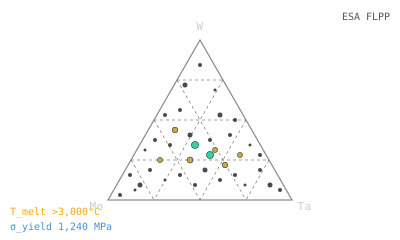
No single-element refractory metal satisfies all four. HEAs composed of W, Mo, Ta, Nb, and Cr offer a combinatorial design space where trade-offs between melting point, oxide scale stability, and room-temperature ductility can be optimised.
Approach
- Computational screening — CALPHAD phase predictions and DFT formation energy calculations to narrow the composition space from ~10⁶ candidates to <100 printable alloys
- Additive manufacturing trials — Laser Powder Bed Fusion (LPBF) to calibrate process windows (scan speed, layer thickness, preheat) and characterise defect populations
- Hot-gas validation — Printed coupons tested at ArianeGroup's ERBURIGK facility under representative oxygen-rich preburner conditions, benchmarked against Monel K500
Consortium
Awarded to Bimo Tech as prime contractor under ESA FLPP FIRST! programme:
- Bimo Tech — Project lead, alloy design, computational screening, LPBF synthesis
- ArianeGroup — End-user requirements, hot-gas testing at ERBURIGK, Monel K500 baseline data
Status
Contract awarded January 2025. The project feeds directly into P.R.I.S.M. — SPARK's alloy targets define the fitness function for PRISM's autonomous discovery pipeline.