NiTiCu: Fast-Cycling Actuator Materials
Advancing the TRL of solid-state space actuators from TRL 2 to TRL 5, targeting actuation frequencies of 50-100 Hz for lubricant-free orbital robotics, fast steering mirrors, and active micro-vibration damping.
The Problem
Shape memory alloys like NiTi deliver excellent force density but actuate too slowly in space (1-10 Hz). NiTi's high resistivity (~80 uOhm-cm) makes Joule heating inefficient, and vacuum restricts heat dissipation to radiation only. Standard coatings fail: electroplated copper delaminates after ~3,000 cycles, thermal spray creates brittle intermetallic zones.
The Solution
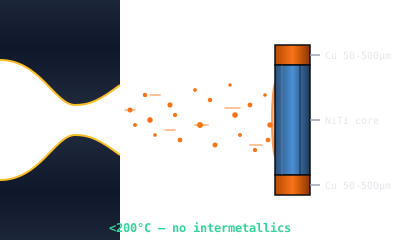
Coat structured NiTi substrates with 50-500 um of copper using Cold Gas Spray (CGS) deposition.
Why CGS Works
- Solid-state bonding: CGS operates below 200C, creating metallurgical bonds through mechanical interlocking and adiabatic shear instability — no brittle Cu-Ti intermetallics
- Skin effect heating: High-frequency AC (100 kHz) forces current through the conductive copper layer (skin depth ~210 um) instead of the resistive NiTi core, enabling rapid uniform heating
- Radiative cooling: CGS creates highly textured surfaces with emissivity ~0.30 (vs 0.02 for polished copper), increasing radiative cooling power 5-10x in vacuum
The Scientific Gap
The thermal cycling durability of CGS copper on NiTi under extreme transformation strains (4-8%) is completely uncharacterized in published literature. This project will systematically test substrate preparations and coating thicknesses.
The Killer Test
10,000 thermal cycles in vacuum (10^-3 Pa). Success metric: zero coating delamination.
Target Applications
- Lubricant-free orbital robotics
- Fast steering mirrors for laser communications
- Active micro-vibration damping
Status
Selected for ESA OSIP Proposal Phase (January 30, 2026). Full proposal deadline: March 13, 2026.